Home Cooking in the Japanese Queer Home
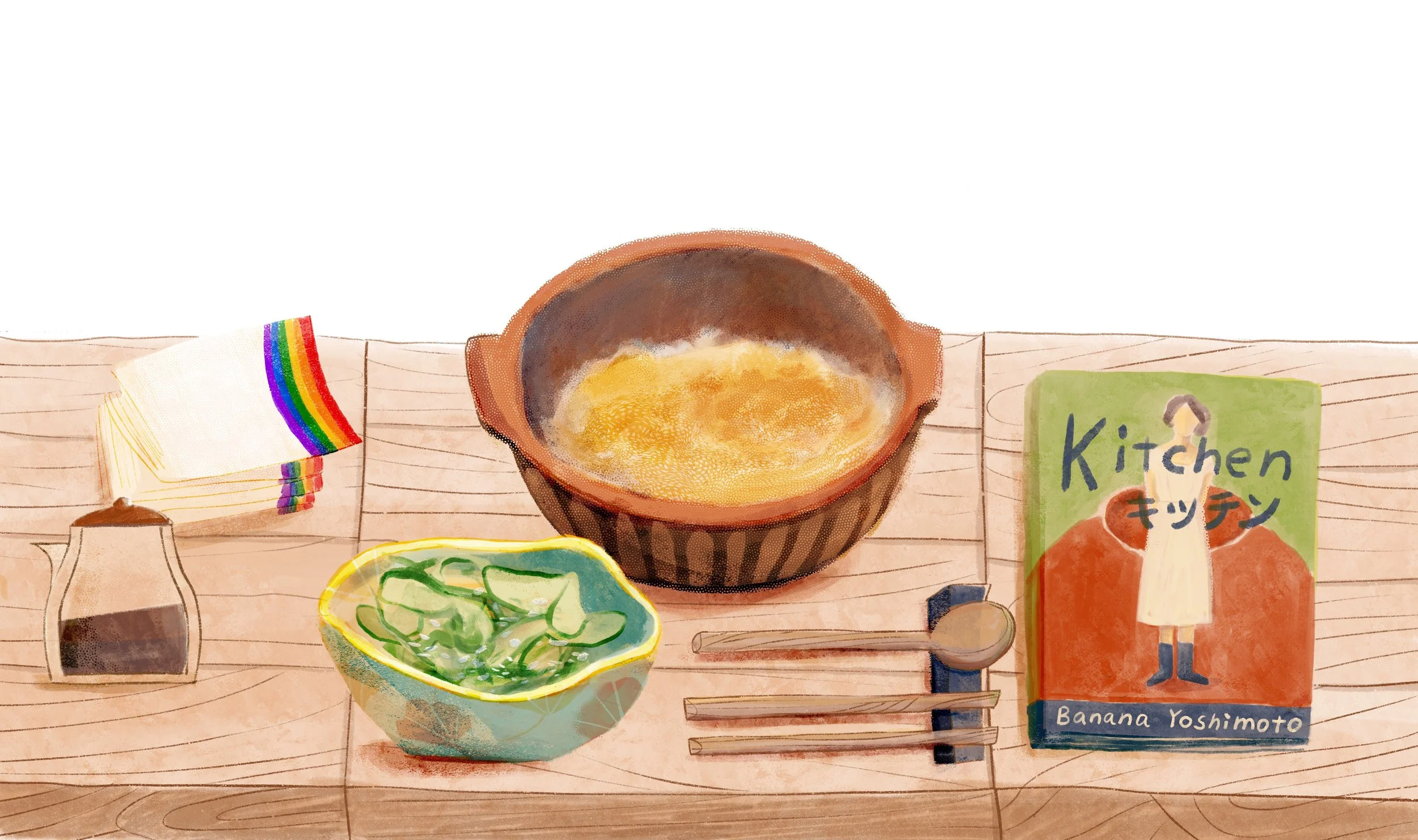
Illustration by Yu-Ting Cheng
“She attacked the food. Cucumber salad and soupy rice with eggs - with gusto. [...] There we were, eating breakfast, all sorts of things set out directly on the floor (there was no table). The sunlight shone through our cups, and our cold green tea reflected prettily against the floor.”
Mourning, Loneliness, and Food
Kitchen (1988) by Banana Yoshimoto, then aged 23, marked a turning point in the new Japanese literary generation of the 80s. Published at the brink of third-wave feminism it’s a timely novel addressing issues of gender and gender roles in a patriarchal society. Poetic and strange, Yoshimoto's debut novel contains the essential themes that we encounter in her later works: life and death and its mourning, loneliness, and emotional fragility through the destinies of young people at the dawn of their adult life.
None of the story's main characters come from a conventional family with two biological parents. Raised by her grandmother who passes away at the start of the novel, the protagonist Mikage Sakurai is soon taken in by Yuichi and Eriko Tanabe, a co-student and his transgender mother (Yuichi’s biological father who now identifies as his mother) although they barely know each other. As a token of gratitude, Mikage, whose favorite place we learn in the opening is the kitchen, “The place I like the best in the world is the kitchen”, starts cooking for her new family. Sadly, Eriko is tragically murdered by a stalker because of her identity. Death is therefore at every turn in the novel. However, where there is death and immense loneliness, there is also an appetite for life, beautifully translated into the literary motif of food.
Good Wife, Wise Mother
Food is often used as a literary motif to suggest class and gender.
Japanese cuisine holds a strong national and international culinary image and is often associated with ancient and traditional knowledge and expertise. However, as we know it today, Japanese national cuisine is a modern construct born out of reforms made during the Meiji restoration (1867–1912).
Modernization of the nation Japan thus started 150 years ago with a large set of implementations called “the enlightenment civilization” to be recognized as a modern state by the western allies. The country would undergo a major change by reforming its political system and industrializing its economy based on western models. Among them was the “Ryosai Kenbo” coined as “Good Wife, Wise Mother”, an ideology that justified and rationalized the division of labor by gender in the manner of “men work while women do housework and raise children”. By giving women the professional space of “The Home” and “The Kitchen”, Japan would ensure its population's steady growth which was necessary to become a modern nation-state. Productive and reproductive capacities for industrial labor and military power starting in the domestic space.
The Anglo-American domestic ideal of the “shufu” (housewife) as the sole aspiration for adult women became popular among Japanese intellectuals and reformers and was widely spread in the media. In parallel, the word “katei” (home) emerged, and “katei” related columns became popular in magazines. The kitchen became the modern “shufu’s” arena to shine, an idea largely supported in magazines and other media targeting middle-class women. And so, through this new ideal of womanhood, the national standard for home cookery was born. Companies seized the opportunity for new businesses, making kitchen equipment and other utensils “essential” to perform the duty of a true housewife. The stereotypical Japanese meal structure “ichiju sansai” (One soup three dishes) was launched as the center of domesticity alongside the family-gathering furniture “the table” where not only meals but also morals were to be shared. Cooking classes were implemented at school and the sum of these social changes contributed to the standardization of housewifery and home-cooked meals across the country.
Freeing the Housewife
At first glance, Migake can be seen as the epitome of housewifery. She cooks for her family consisting of two males, she’s experienced with kitchen utensils, reads cooking magazines, and takes cooking classes.
Whereas second-wave Japanese feminists refuted anything that had to do with home cooking and other activities conforming the woman to a certain role, Mikage does not hide her passion for the production, preparation, and consumption of food.
However, when paying closer attention to the text, Mikages love for home cooking and vegetable droppings is not tied down by the burden of “Ryosai Kenbo”. She conforms neither to the role of the typical housewife nor to the rules of Japanese home cooking.
Perhaps most noticeable is the missing father in the household. Mikages new family consists of a transgender mother and a shy, emotional young man. Without a father who sits and waits for the woman to serve him meals and clean the home, Mikage is freed from her domestic duties. There is no obligation in cooking for Eriko and Yuichi as both have been content living on takeaway, but Mikage does it out of love. Furthermore, the table, the most important centerpiece of the “Ryosai Kenbo” ideology, is non-existent. Rather Eriko, Yuichi, and Mikage eat directly on the floor. And rarely do they eat together but prefer to eat at times that are the most convenient for each one.
As for the normative meal structure consisting of one soup and three dishes, Mikage couldn’t care less. She cooks how it pleases her whenever it pleases her, whether it be one dish in the morning or a buffet at midnight. She does not identify with the other women taking the cooking classes and somewhat feels sorry for them. They might not be aware of it, but unlike Mikage they are not there for the cooking itself, but to perform a duty.
Another clue that is lost in the translation is that Yoshimoto chose to use the English loan word “Kitchin” (Kitchen) as the Japanese book title instead of its Japanese counterpart “daidokoro”, suggesting a distance from the kitchen as a workspace.
Lastly, to Mikage the kitchen not only serves as a place for preparing meals but also serves as a bedroom, and in the broader sense a safe place, a place of comfort and healing.
The novel is a love letter to the non-traditional family where the kitchen and its food and meals are where the family is (re)built beyond blood ties.
Suggestions for further reading:
Kitchen (1988) by Banana Yoshimoto
Modern Japanese Cuisine: Food, Power and National Identity (2006) by Katarzyna J. Cwiertka
Reading Food in Modern Japanese Literature (2008) by Tomoko Aoyama
Ōe and Beyond: Fiction in Contemporary Japan (1999) by Stephen Snyder and Philip Gabriel